

IELTS Reading Tips: Easy Strategies to Score Band 7+
Scoring a Band 7 in the IELTS Reading test is absolutely achievable, but not if you’re relying on generic advice like “read more” or “improve vocabulary.” In this guide, I’ll walk you through practical, research-backed IELTS Reading tips that genuinely work, especially if you’re stuck at Band 5 or 5.5.
Whether you’re preparing for the Academic or General Training test, these strategies will help you improve speed, accuracy, and confidence without feeling overwhelmed.
Why Most Students Struggle With IELTS Reading (Even Good Readers Do)
Here’s a surprising truth:
The IELTS Reading test does not measure how well you understand English — it measures how efficiently you can find answers under pressure.
Many students who are fluent in English still score below 7 because they:
-
read too slowly
-
Try to understand every word
-
panic when facing unfamiliar vocabulary
-
rely on intuition instead of techniques
This article provides you with easy, reliable strategies that you can apply immediately — supported by proven test-taking methods and my own tutoring experience, which has helped students jump from Band 5 to 7+ within weeks.
Proven IELTS Reading Tips for Band 7 (With Examples & Techniques)

Let’s break down the most effective strategies one by one.
1. IELTS Reading Tips for Band 7: Master Skimming & Scanning Techniques
Most students think they skim well — until the test day reveals otherwise.
Skimming = Understanding the general idea
Spend 60–90 seconds per passage, quickly identifying:
- the topic
- writer’s opinion
- purpose
- structure
You’re NOT reading for detail — you’re mapping the passage.
Scanning = Finding specific information
Use scanning for keywords in questions:
- names
- numbers
- years
- statistics
- unique nouns
These are easy to spot even without understanding the full sentence.
Training resource:
You can practice skimming using articles from National Geographic or BBC Future, both match IELTS difficulty.
2. Stop Reading the Entire Passage — Start With the Questions First
This is the biggest mistake Band-5 students make:
reading the full passage before even knowing what you’re looking for.
Instead, follow this sequence:
Step-by-step system
- Read the title and quickly skim the passage for 60 seconds.
- Jump to the questions.
- Identify keywords.
- Scan for those words in the text.
- Read only the small section needed to find the answer.
This saves 5–7 minutes per passage — crucial for the 40-minute test.
3. Learn Keyword Transformation (The Secret to Band 7 Accuracy)
IELTS rarely uses the exact wording from the question. Instead, they use synonyms, paraphrases, or restructured sentences.
Example:
Question:
“The company increased production in 2019.”
Text:
“Output grew significantly during the year 2019.”
- “Increased” → “grew.”
- “Production” → “output”
Train your brain to recognize these transformations.
A great free resource is the Cambridge Dictionary’s “smart thesaurus” feature.
4. IELTS Reading Strategy: Avoid Common True/False/Not Given Traps
True/False/Not Given questions are the most feared, and for good reason.
Here are the traps IELTS uses:
IELTS Traps to Watch Out For
- Using the opposite meaning to make you choose False
- Giving partial information (leading you to choose True instead of NG)
- Repeating keywords to mislead you
- Using absolute words (“always,” “never,” “completely”)
Quick rule:
- TRUE → The meaning matches.
- FALSE → The meaning contradicts.
- NOT GIVEN → The text does NOT answer the question.
Most Band-5 students overthink NG questions.
Band-7 students learn to take them literally.

5. Build Vocabulary the Smart Way (Context > Memorizing)
While vocabulary lists help, they’re not enough for Band 7.
The smarter approach?
Learn vocabulary in context
When reading an article, write down:
- the sentence
- the new word
- Its meaning in this context
- How the writer uses it
This improves not only meaning recognition but also keyword transformation skills, which directly impacts your Reading score.
Suggested reading practice platforms:
6. Use Time Management Strategies Designed for Band 7+
Here’s the time structure I teach my students:
| Task | Recommended Time | Purpose |
|---|---|---|
| Passage 1 | 12–14 minutes | Should be easiest |
| Passage 2 | 14–16 minutes | Medium difficulty |
| Passage 3 | 16–18 minutes | Most challenging |
| Review | 1–2 minutes | Fix doubtful answers |
Golden rule:
If you’re stuck for more than 55 seconds, skip and return later.
This helps avoid panic, reduces careless mistakes, and boosts overall accuracy.
7. Develop a Strategy for Each Question Type
Each question type requires a unique approach.
Here are the most important ones:
IELTS Reading Strategy For Matching Headings
Matching headings tests logical structure, not detailed reading.
Tips for success:
- Read the first and last sentence of each paragraph
- Look for patterns: cause/effect, problem/solution, contrast
- Ignore examples and dates — they are irrelevant for headings
IELTS Reading MCQ Strategy for Band 7
The distractor options are designed to look correct.
Use this 3-step MCQ method:
- Predict the answer before reading the options
- Eliminate obviously wrong choices
- Only choose from what the text proves, not what you assume
Summary Completion Tips for IELTS Reading
Watch for:
- synonyms
- paraphrases
- word form changes (e.g., “discover” → “discovery”)
Use grammar to eliminate wrong answers.
Matching Information Techniques for IELTS Reading
Scan for unique features:
- names
- dates
- technical words
- capital letters
These save time and help pinpoint the paragraph instantly.
8. Consistency Beats Intensity: Build Daily Reading Habits
Here’s something most test-takers get wrong:
Reading 3 passages one day and nothing for the next week won’t improve your score.
Instead, adopt a 20-minute daily routine:
-
10 minutes → skim one article
-
5 minutes → write keywords
-
5 minutes → summarize
This builds mental stamina and improves reading intuition.
9. Practice With Official IELTS Material Only
To achieve Band 7+, you need to study the right material.
Recommended sources:
- Cambridge IELTS Book Series (1–18)
- IELTS.org Sample Questions
- British Council Practice Tests
- IDP IELTS Preparation Materials
These reflect the real difficulty level and question patterns.
Avoid unofficial apps with unrealistic questions — they often confuse students.
10. Use a Monitoring System to Track Improvement
Band-7 achievers don’t just practice — they analyze.
After each practice test, track:
- accuracy percentage
- Which question types did you miss
- time spent per passage
- mistake patterns
- vocabulary gaps
Over time, this creates a laser-focused improvement plan.
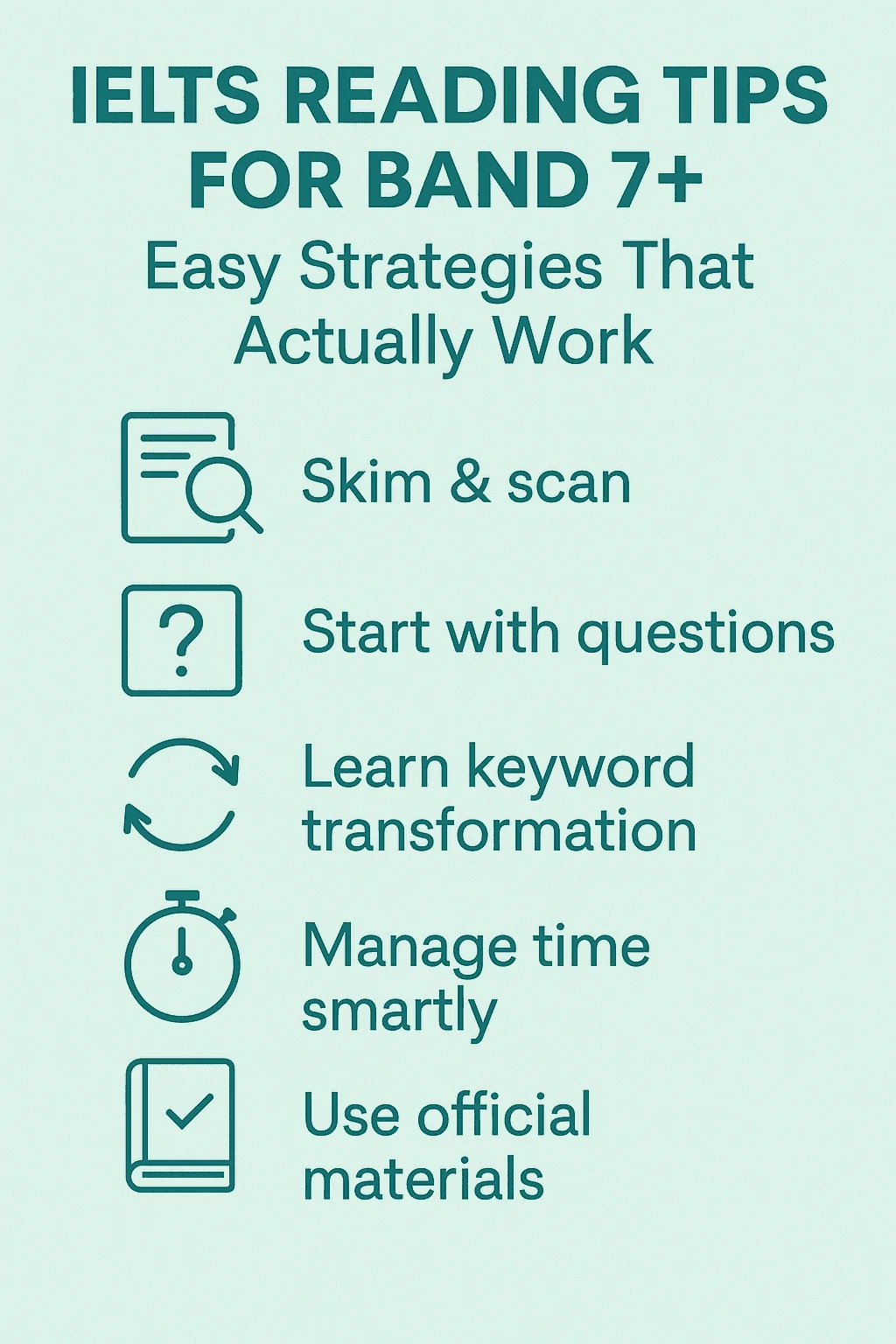
Top 5 IELTS Reading Tips for Band 7+ (At a Glance)
| Tip | Why It Works |
|---|---|
| Skim & scan | Reduces time spent on unnecessary reading |
| Start with questions | Improves focus & answer accuracy |
| Learn keyword transformation | Helps identify paraphrased answers |
| Manage time smartly | Keeps you calm and consistent |
| Use official materials | Matches real exam difficulty |
Conclusion: Band 7 Is Not About English — It’s About Strategy
If you apply the strategies above consistently, IELTS Reading becomes far less intimidating. Remember:
- You don’t need perfect English
- You don’t need to understand every sentence
- You don’t need to read the whole passage
You do need a system — and now you have one.
If you found these IELTS Reading tips helpful, share your current score goal in the comments.
Want more strategies? Check out my guides on IELTS Writing, Listening, and Speaking — or subscribe for weekly tips to help you reach your Band 7+ dream faster.